

On an event billed ‘Judgement Day’, there is a certain irony to the circus show that occurred on Saturday night.
Tommy Fury, brother of lineal Heavyweight boxing champion Tyson, edged YouTuber KSI via majority decision over six rounds – despite receiving a bizarre point deduction for strikes to the back of the head.
Before the main event even began, Twittersphere (apologies, X-sphere) was already ablaze with discussions about the most comical of co-main events in recent memory. Bundled with the post-fight rage of KSI’s prepubescent disciples and it sparked fears of boiling into a true geopolitical issue.
Indeed, Google searches for KSI-Fury in the UK during and after the event remain almost double that of the Israel-Palestine conflict.
To lump greater farce onto the situation, there was a misreading of the scorecards on the night that should have confirmed that Fury had won via unanimous decision.
Yet, if the sold-out Manchester AO Arena was not proof enough that these circus shows produce serious cheddar, look no further than the ringside duo of Eddie Hearn (Chairman of Matchroom Sport) and Nisse Sauerland (MISFITS promotion co-founder).
The lines between legitimate and celebrity sport has blurred. Even Gordan Ryan, a Brazilian Jiu-Jitsu wizard, was reduced to a pantomime role as Logan Paul’s ‘security’. The transcendent rise of MF & DAZN: X Series boxing events is well beyond the realms of social media at this point.
You may be wondering how this relates to a Tommy Fury vs KSI fight analysis. Well, understanding the context is crucial, as it justifies why even this lowly calibre of boxing necessitates proper analysis.
This wasn’t a rehearsed fight, nor a scripted result, even if KSI happens to be the CEO of MISFITS.
No, what we witnessed on Saturday night was the stylistic clash of two novice boxers amid a juiced-up atmosphere that is best described as the Roman Coliseum on steroids.
KSI can not or will not counter
KSI’s hands-down, bouncing stance is a divisive topic. Some love it, some hate it. Of course, those who love it tend not to have the deepest grasp of the sport. However, that isn’t to say there are no benefits to his unconventional.
Low hands create an unusual angle from which punches can be launched, throwing an opponent off their typical reads. Meanwhile, the pendulum step from a wide base (as KSI uses) allows for rapid distance coverage, helping to catch opponents off guard.

Even though KSI has employed this style throughout his career, the speed he generates caught Fury off guard within the first minute of the fight. KSI’s lunging 1-2 punches lack nuance, but against an opponent like Fury, who tends to move back on a straight line, they were effective.
As seen in the images below, KSI’s athleticism and pendulum step enabled him to rush into the pocket and ask immediate questions of Fury’s defence. A quick extension of KSI’s lead hand baited Fury into a parry across his body, and although expecting the follow-up right straight, Fury’s wide base left him a step slower than KSI. The YouTuber landed flush to the side of Fury’s head, yet his inexperience is evidenced by his failure to properly dig his right foot into the canvas and produce meaningful power.
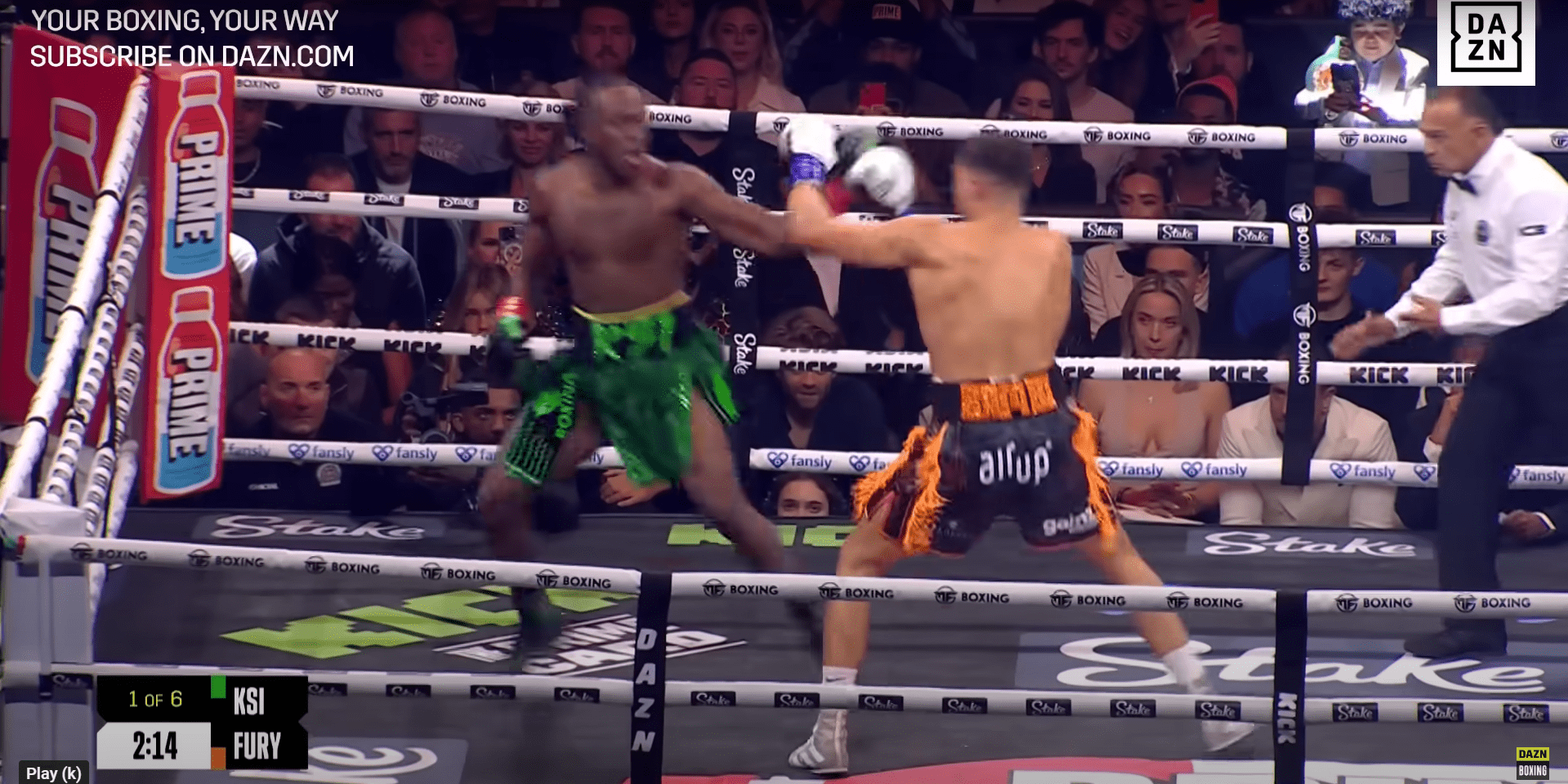
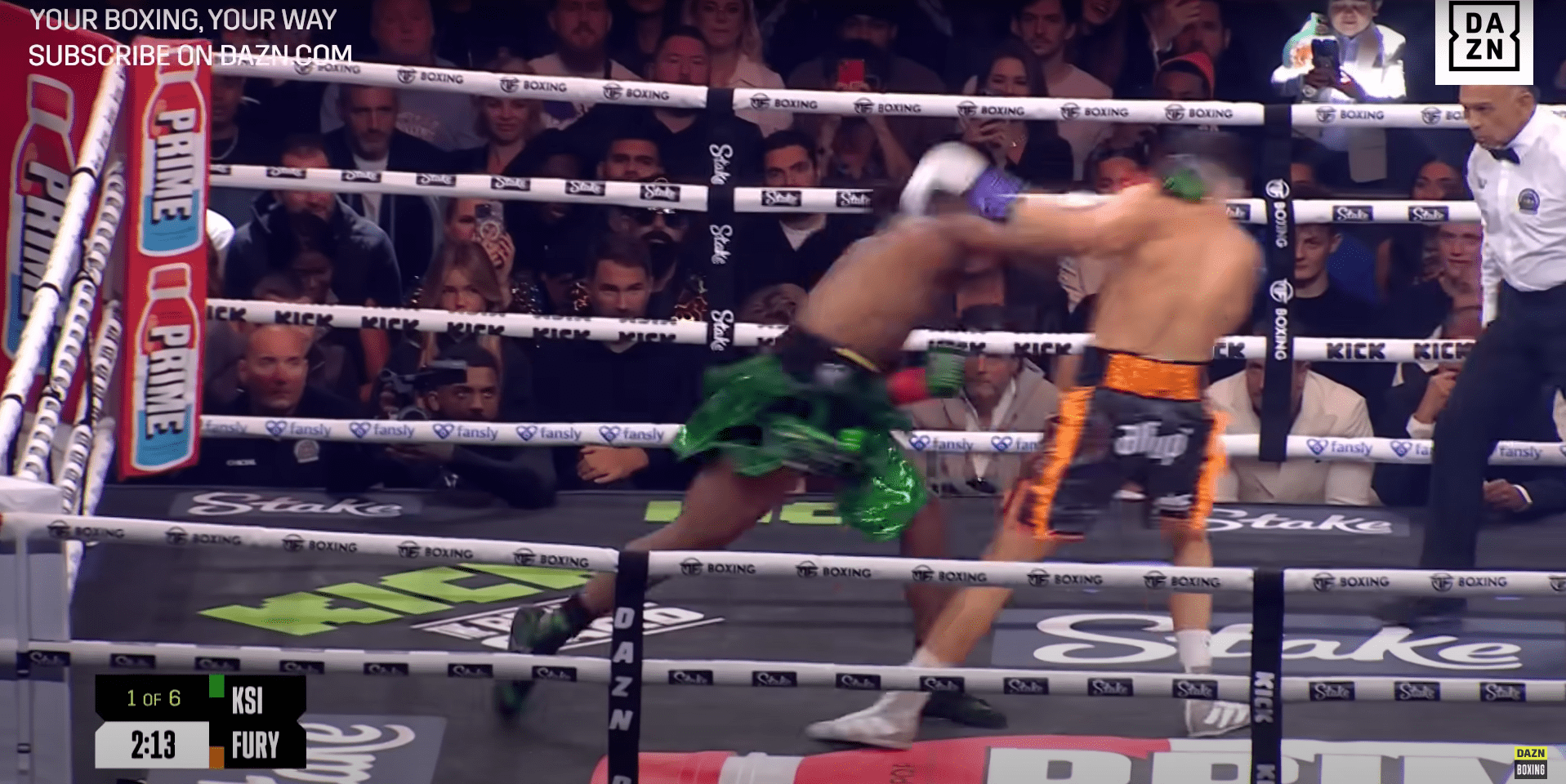
The pendulum step is a valid technique in boxing at all levels, and it’s evident that KSI has adopted this approach based on his choice of gym and trainer. Under the guidance of coach Alexis Demetriades, founder of London Shootfighters, KSI’s style resembles that of former Bellator title challenger Michael Venom Page (MVP).
For all the can crushing that MVP enjoyed in the B-tier MMA promotion, few can deny his innate grasp of timing and shot selection. Unfortunately for KSI, a latecomer to combat sports, he lacks both the intellect and confidence to counter from his current stance.
This deficiency was particularly notable near the end of the third round. After launching a telegraphed straight to the body, KSI was forced onto his heels by a swarming barrage of hooks from Fury. KSI’s long retreating steps allowed him to exit the pocket unscathed, before hitting a cute turn to position himself for a counter.
Having beat Fury to punch in the early exchanges, KSI is well aware of his edge in hand speed over Fury. With Fury’s sloppy jab seeing him draw his weight on to his front foot, he momentarily lost the threat of his powerful right hand, opening up a golden opportunity for KSI to counter risk-free. Frustratingly, KSI instead opts to dip at the hips and wrap Fury into the clinch to close out round three – a round he lost on all three of the judges’ scorecards.


Fury’s lead hook-clinch meta
Boasting the rippling muscles of a Greek God, you’d be forgiven for believing Tommy Fury enjoys freakish power and speed. On the contrary, the gypsy fighter is rigid upright boxer with a punch that would struggle to take the skin off a rice pudding.
Countless flaws can be dissected in his game, but the Love Island alumnus keeps winning. To comprehend how Molly Mae’s lovebird succeeds at this level, one must appreciate his unique approach to front-foot offense – the lead hook.
The lead hook is one of the six fundamental punches a boxer must learn. It is a strike that appears in the earliest boxing manuals and has been the cause of some of the sport’s most iconic knockouts. *cough* Breidis Prescott starching Amir Khan in 51 seconds *cough*. Despite the extensive history of lead hook success, it remains an underutilised shot by amateurs and professionals.
How surprising then, that it is Tommy Fury who lead the lead hook renaissance.
Rather than leading with the jab, Fury instead adopted the left hook as his primary tool. As seen in the images below, even with KSI backed on to the ropes, Fury is content with throwing a single left hook. As the YouTuber dips to his right, Fury’s left hand comfortably sails over the top – it appears to be a missed opportunity at first glance.
Yet by forcing KSI to bend low at the hips, it allowed Fury to safely close the distance and weigh down on his opponent from above. The ‘misfired’ lead hook instead snugly wraps around KSI’s neck. With the additional factor of referee Mark Calo-oy failing to effectively police the clinch, it left KSI with no choice but to bear Fury’s weight throughout the fight.


As the fight progressed, KSI’s output declined significantly, with CompuBox punch stats revealing that he threw only 73 punches in the final four rounds, compared to 51 in the opening two. Fury’s game plan to depart from the jab in favour of the left hook was pivotal in this decline.
This tactic isn’t a crowd pleaser, but it effectively mitigates Fury’s biggest weakness: his static upper body. By throwing then clinching, no matter if it lands or not, Fury creates the illusion of activity to the judges while also frustrating his opponent. Furthermore, Fury will occasionally follow the lead hook with a right hand, keeping the threat of his biggest weapon in the back of his opponent’s mind.
While the grudge match may have been unwatchable at times, there is a method to the madness of both fighters. In this brave new world of ‘professional boxing’, however, you must tailor your expectations for more definitive fireworks at the press conferences than in the centre of the ring.
Leave a Reply